
Charsadda sits at the intersection of vulnerability and opportunity.
Surrounded by major river systems, the district has long lived with the reality of flooding, but in recent years, that reality has intensified. Changing environmental patterns, combined with deforestation and the encroachment of natural waterways, have made flooding more frequent and more damaging. Each cycle leaves behind not just physical destruction, but disrupted livelihoods and growing uncertainty for communities.
At the same time, everyday challenges continue to shape life in the district. Road connectivity remains uneven, energy access is inconsistent, and sanitation systems struggle to keep pace with population needs. For young people, limited access to quality education and employment opportunities narrows pathways for growth and economic mobility.
These are not isolated issues. They are deeply interconnected, and they point to a larger need: spaces where people can come together to make sense of these challenges, share perspectives, and collectively explore what solutions might look like.
Creating Space for Dialogue
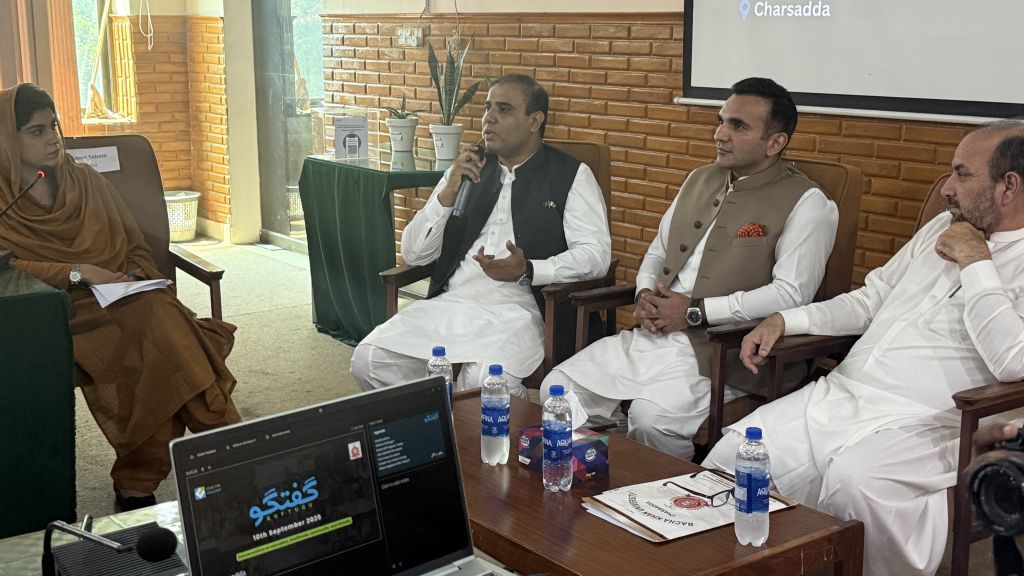
Recognising this need, Code for Pakistan hosted the Guftugu (Civic Town Hall), Charsadda at Bacha Khan University. The event was curated in collaboration with the Offices of Research, Innovation and Commercialisation Department, led by Dr Muhammad Kamran Khan, Director of ORIC at Bacha Khan University.
The goal was simple but significant: to create a space where conversation could move beyond individual concerns toward shared understanding and collective thinking.
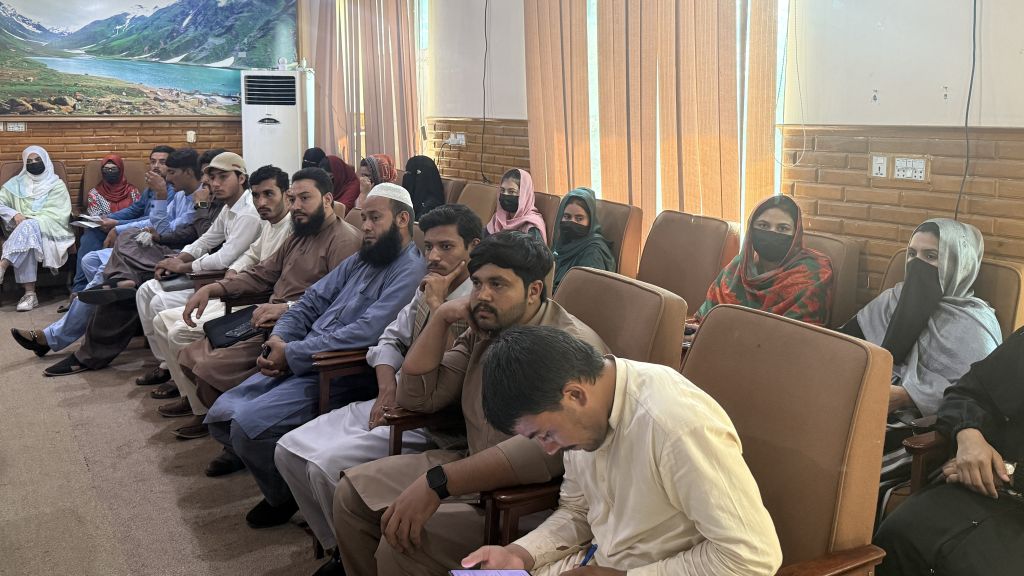
The town hall brought together a diverse group of stakeholders, students, youth, faculty members, community representatives, public sector officials, entrepreneurs, members of the business community, and civil society actors. Each group brought a different lens, but all were connected by a shared stake in Charsadda’s future.
The panel featured Dr Shakeel Khan (Chairman, Business Incubation Centre, University of Peshawar), Mr Noman Akbar (Senior Vice President, Charsadda Chamber of Commerce), Dr Iftikhar Alam (Chairman Human Nutrition & Dietetics, Bacha Khan University), and Mr Pir Amad Ali Shah (Project Coordinator, Durshal Mardan). The discussion was moderated by Ms Anum Saleem (Lecturer, Bacha Khan University), with active participation from university faculty, students, and alumni.
Highlights from the Dialogue
Participants spoke about how climate pressures are compounding existing vulnerabilities. Increased rainfall, changing land use patterns, and pressure on natural systems are making flooding more difficult to manage. At the same time, infrastructure development has not always kept pace with the district’s evolving needs.
What emerged early in the conversation was a shared recognition: Charsadda’s challenges are not new, but they are becoming more urgent.
But the discussion did not remain focused solely on challenges; it began to shift toward possibility.
Dr Shakeel Khan highlighted the role that young people can play in shaping more sustainable futures. He spoke about the growing importance of green skills and the potential of circular economy approaches to create both environmental and economic value. From rethinking local resource use to encouraging green entrepreneurship, he emphasised that solutions can emerge from within communities themselves, especially when supported by institutions like universities.
From the business community’s perspective, Mr Noman Akbar drew attention to the disconnect between education and employment. While graduates continue to enter the workforce, opportunities within the local economy remain limited. He highlighted the need for stronger collaboration between businesses, academic institutions, and public sector stakeholders to align skills with market needs better and create viable career pathways.
Dr Iftikhar Alam highlighted the potential of leveraging locally available crops, particularly sugarcane, for business ideation and entrepreneurship. He emphasised the importance of establishing small-scale, local production units that can create value-added products such as natural juices and other sugarcane-based goods, enabling communities to generate income while building on existing resources.
Mr Pir Amad Ali Shah shared insights into the government’s ongoing efforts to create employment opportunities for the youth in Charsadda. He also spoke about avenues for promoting local manufacturing – encouraging young people to explore business incubation opportunities available in KP, which can support them in developing and scaling their entrepreneurial ventures.
Across the discussion, one theme remained constant: meaningful progress depends on collaboration.
From Dialogue to Action
What set Charsadda Guftugu apart was what happened after the conversation.
Participants did not just engage, they responded.
Through the What If Box, attendees shared practical ideas rooted in lived experience. Suggestions ranged from improving energy systems and expanding internet access to supporting agricultural innovation and creating more opportunities for youth skill development.
Many participants, particularly students and young professionals, expressed interest in staying involved beyond the event. Conversations around volunteering and local action groups began to take shape, signalling a shift from dialogue to continued engagement.
This is where the Guftugu moves beyond being a one-time event. It becomes a starting point, an entry into longer-term, community-led efforts.
Why Charsadda Guftugu Mattered
In many communities, the challenge is not a lack of ideas; it is a lack of connections and resources to realise the ideas.
Different stakeholders often work in silos, with limited opportunities to engage with one another. As a result, efforts remain fragmented, and potential solutions are never fully realised.
Charsadda Guftugu helped bridge that gap.
By bringing together citizens, institutions, academia, and the private sector in one space, the event created an opportunity for shared understanding. It also demonstrated that when people are given a platform to engage meaningfully, they are willing to contribute not just opinions, but time, ideas, and effort.
It also highlighted the growing role of youth as active participants in shaping their communities, rather than passive observers.
The Way Forward
Charsadda’s story reflects a broader reality across many parts of Pakistan, where climate pressures, infrastructure needs, and youth aspirations are increasingly intersecting.
But it also reflects something else: potential.
The momentum generated through the town hall offers a foundation to build on. Interest in volunteering, the emergence of new ideas, and the willingness of stakeholders to collaborate all point toward the possibility of sustained engagement.
Code for Pakistan aims to continue supporting this momentum by facilitating connections, enabling collaboration, and creating pathways for ideas to evolve into practical initiatives. This includes ongoing engagement with local stakeholders, mentorship for emerging groups, and opportunities to strengthen partnerships across sectors.
The experience from Charsadda will also inform how the Guftugu model continues to evolve in other cities, adapting to local contexts while maintaining its core focus on inclusive dialogue and collective problem-solving.
Because when conversations are sustained and communities are connected, dialogue does more than raise awareness; it creates the conditions for change.